Industrial facilities have long relied on human inspection and manual quality checks to maintain product standards along production lines. As throughput demands increase and tolerance margins tighten, that reliance creates operational exposure. A single inspector working a twelve-hour shift cannot maintain the same detection accuracy at hour eleven as at hour one. The variance is not a matter of effort — it is a matter of human physiology applied to a task that demands machine-level consistency.
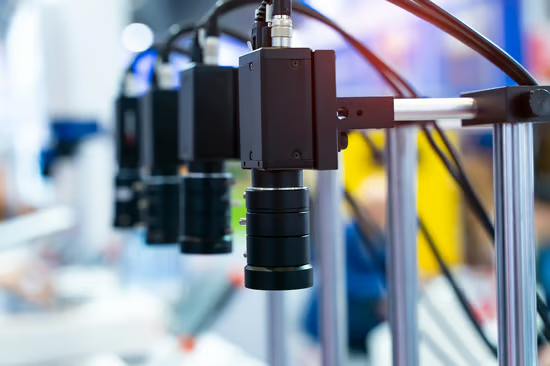
Vision systems address that gap by providing automated, repeatable inspection at line speed. But a vision system operating in isolation — capturing images, flagging defects, logging results — delivers only part of its potential value. The larger benefit comes when that system is embedded within the broader control architecture of a facility: connected to PLCs, SCADA platforms, and MES layers so that its outputs trigger responses, inform decisions, and contribute to production data in real time.
Achieving that level of integration requires more than installing hardware and running a cable. It requires a structured approach to how vision systems communicate, what data they surface, and how the control environment is prepared to receive and act on that information. This framework outlines the key stages and considerations involved in doing that work correctly.
Understanding What Control Systems Vision System Integration Actually Requires
Control systems vision system integration is a process that connects image-based inspection hardware to the programmable logic, communication networks, and software layers that govern how a production environment operates. It is not simply a matter of feeding data from a camera into a controller. The integration requires that both systems — the vision platform and the control architecture — are configured to interpret, exchange, and act on information in a compatible and reliable way.
For facilities evaluating how to approach this technically and operationally, resources focused specifically on control systems vision system integration provide useful grounding in what the process involves and what it demands from both the engineering team and the existing infrastructure.
At the core of this requirement is a communication model. Vision systems must be able to send outputs — pass/fail signals, dimensional data, classification results — through protocols that the control system already understands. This may mean configuring the vision system to communicate over industrial Ethernet standards, discrete I/O lines, or software-based interfaces depending on what the PLC or SCADA platform supports. Without that alignment, the vision system becomes an isolated tool rather than an integrated component.
The Difference Between Connection and Integration
Many engineering teams treat integration as synonymous with connection, but the two are meaningfully different. A vision system that is connected to a network can transmit data. A vision system that is integrated into the control architecture has its outputs mapped to specific control logic — so a failed inspection can trigger a diverter, pause a conveyor, flag a batch in the MES, or alert an operator through the SCADA interface simultaneously.
That distinction matters operationally because connection alone does not create response. If a vision system flags a defect but nothing in the control layer is configured to act on that signal, the value of the detection is limited to a log entry. Integration ensures that the detection is operationally meaningful — that it produces a defined, consistent outcome within the production process.
Mapping the Control Architecture Before Introducing Vision Hardware
One of the most common sources of integration difficulty is introducing vision hardware before the existing control architecture has been properly assessed. Every production environment has its own mix of controllers, communication protocols, network topology, and software platforms. A vision system that works seamlessly in one facility may require significant configuration adjustment in another because the underlying control environments differ.
The preparation phase should involve documenting what controllers are present, what communication standards they support, and what real-time constraints the network operates under. Cycle time, network latency, and the timing of inspection triggers all affect whether a vision system can be reliably synchronized with line speed and control logic execution. These are not questions that can be answered after the hardware is installed.
Protocol Compatibility and Its Downstream Effects
Industrial communication protocols are not interchangeable. EtherNet/IP, PROFINET, Modbus TCP, and OPC-UA each carry different performance characteristics, and not every vision system supports all of them natively. Selecting a vision platform without verifying protocol compatibility with the existing PLC environment can result in integration workarounds — gateways, conversion layers, or custom software bridges — that introduce latency, add failure points, and complicate long-term maintenance.
Protocol alignment is also relevant when vision systems need to communicate upstream into MES or ERP platforms. The path from a vision result to a production record often passes through multiple software layers, and each handoff point requires that data formats, timing, and communication methods are compatible throughout the chain.
Timing and Synchronization with Production Equipment
Vision systems are time-sensitive tools. They must capture an image at the exact moment a part is in the correct position, under consistent lighting conditions, and within the inspection window defined by line speed. In a control architecture, this typically means the vision system receives a trigger signal from a photoelectric sensor, encoder, or PLC output that is precisely timed to the production cycle.
If that synchronization is not properly configured, inspection results become unreliable — not because the vision system cannot detect defects, but because it is capturing images at the wrong moment or under inconsistent conditions. Timing configuration is part of control systems vision system integration and must be treated as a technical deliverable, not an afterthought.
Structuring the Data Flow Between Vision and Control Layers
A well-integrated vision system produces more than a binary pass/fail output. It can generate dimensional measurements, classification categories, positional data, and statistical information about product quality over time. How that data is structured and routed through the control architecture determines how much of that value the facility can actually use.
At the PLC level, discrete outputs are often sufficient for real-time control decisions — a single bit that tells a downstream diverter to reject a part. But for quality tracking, trend analysis, and process adjustment, richer data needs to travel to SCADA and MES layers where it can be stored, visualized, and acted upon by engineers and quality teams. Designing the data flow requires decisions about what information travels where, at what frequency, and in what format.
Avoiding Data Overload in the Control Environment
Vision systems are capable of generating large volumes of data — images, inspection results, timestamps, measurement values — and there is a tendency to capture everything available. In practice, transmitting excessive data volumes to controllers or SCADA systems can burden the network and slow the response times of other control functions. The goal is not to maximize data transmission but to identify what information is operationally necessary and route it appropriately.
This requires a deliberate scoping exercise during the integration design phase. Engineers should define which outputs are needed for real-time control, which are needed for quality records, and which are needed for periodic analysis — and then configure the vision system and communication paths accordingly. As noted in guidance from the International Society of Automation, the design of industrial data architecture should reflect operational requirements rather than technical capability alone.
Managing Change and Ongoing Maintenance After Integration
Integration work does not end when the vision system is commissioned. Production environments change — new product variants are introduced, line configurations are adjusted, upstream processes shift tolerances. Each of those changes can affect how a vision system performs and how its outputs interact with the control architecture.
Control systems vision system integration must include provisions for ongoing management: documentation of the integration configuration, procedures for updating inspection parameters without disrupting control logic, and defined processes for testing changes before they are applied in production. Without that structure, changes made by one team can inadvertently affect the behavior of another system, creating fault conditions that are difficult to diagnose.
Calibration, Drift, and Environmental Factors
Vision systems are sensitive to changes in their physical environment. Lighting degradation, lens contamination, vibration, and temperature variation can all affect inspection accuracy over time. In an integrated control environment, a gradual drift in vision system performance does not always produce obvious faults — it may simply shift the threshold between detected and undetected defects in ways that are not immediately visible in production data.
Establishing a calibration schedule and embedding performance monitoring into the SCADA layer allows facilities to detect drift before it affects product quality. This is part of treating the vision system as a maintained production asset rather than a set-and-forget installation.
Cross-Functional Alignment as a Technical Requirement
Control systems vision system integration involves disciplines that do not always work from the same set of priorities. Controls engineers focus on logic, timing, and network behavior. Quality engineers focus on inspection criteria, defect categories, and product standards. IT and OT teams each have concerns about network security, data access, and system boundaries. When these groups work in isolation during an integration project, the result is often a system that functions technically but does not serve the actual operational need.
Effective integration requires that these groups participate in the design process from the beginning — not as reviewers of a completed design, but as contributors to decisions about what the system needs to do, how it will be used, and how it will be maintained. The technical architecture of a vision integration is shaped by those functional requirements, and getting them right requires input from the people who will depend on the system daily.
Closing Considerations
Integrating vision systems into industrial control architectures is a structured engineering undertaking. The value it delivers — consistent inspection, real-time control response, and reliable production data — depends on how carefully the integration is designed and implemented, not just on the capability of the vision hardware itself.
Facilities that approach this work systematically, beginning with a clear understanding of their control environment and defining data flows before installing hardware, are better positioned to achieve stable, maintainable integrations. Those that treat it primarily as a hardware procurement exercise often find themselves managing workarounds that limit the system’s usefulness and complicate future changes.
The framework outlined here is not a guarantee of success, but it reflects the conditions that distinguish integrations that perform reliably over time from those that require ongoing remediation. Understanding the distinction between connection and integration, preparing the control architecture before introducing new hardware, and designing data flows around operational need rather than technical capacity are the principles that make the difference in practice.