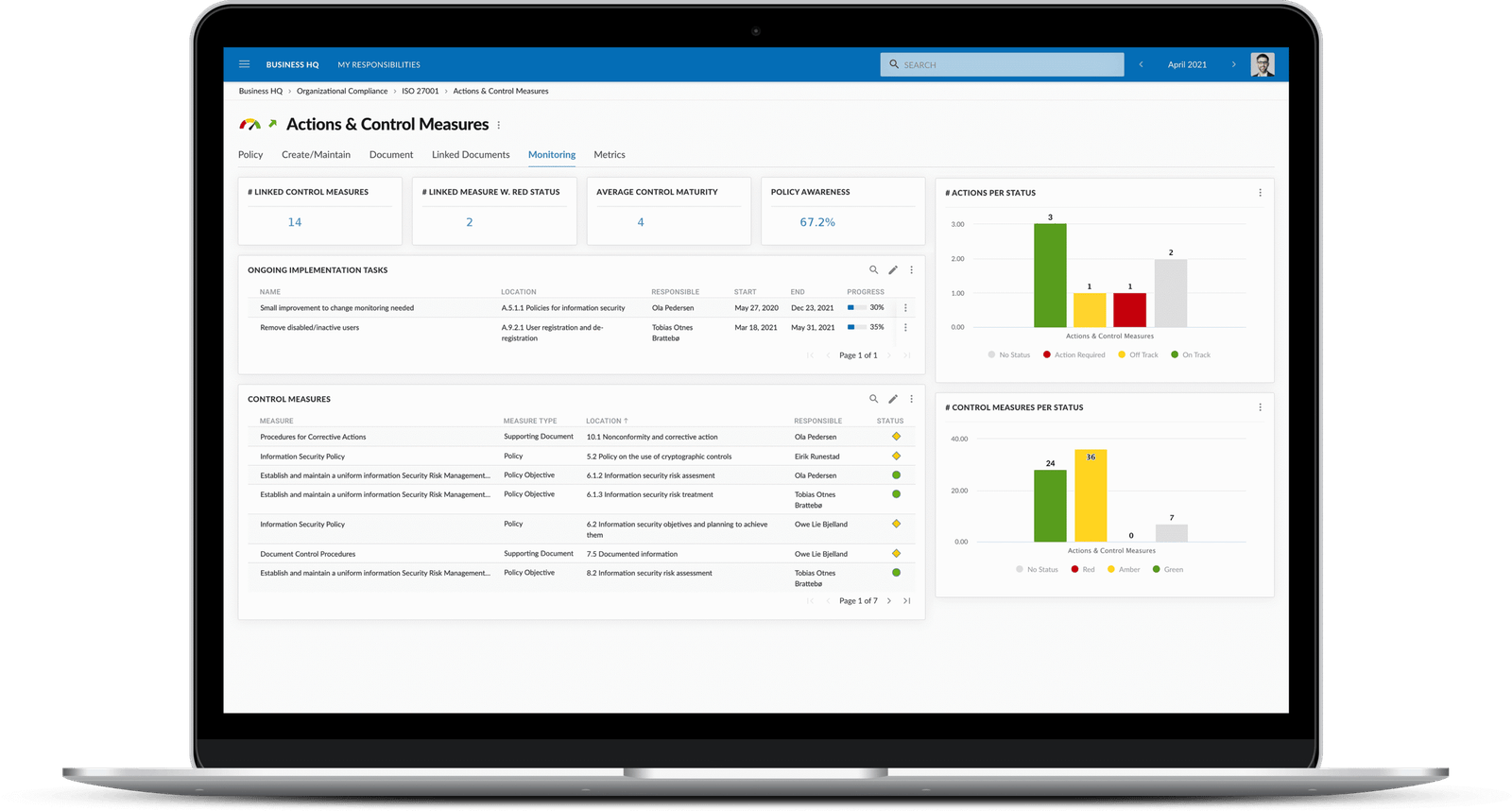
Regulatory obligations now guide daily decisions across finance, HR, operations, IT, and legal teams. They influence how work is approved, recorded, and reviewed well beyond audit cycles. Compliance management software supports this shift by creating shared visibility, clear ownership, and steady execution across departments. Many organizations are already doing the right work. The question is whether that work is visible when it moves between teams.
When information flows smoothly, updates stay current and responsibilities remain clear. Teams can see what is complete and what comes next without extra follow-ups. Leaders gain timely insight without interrupting progress. Standards bodies such as NIST and ISO reflect this direction by emphasizing continuous oversight as part of normal operations.
In this blog, we explain how compliance management software strengthens key business functions and supports clearer, more consistent work across teams.
Why Compliance Touches More Than the Compliance Team
Compliance obligations already exist inside finance, HR, operations, IT, sales, and legal workflows. You encounter them through approvals, documentation, reviews, and controls that are part of everyday work. Compliance moves with execution, not just audits.
The strain appears when each function tracks obligations independently. Even well-run teams lose alignment when there is no shared system holding context, ownership, and status together.
You typically see the effects of fragmented tracking in the following ways:
- The same requirement is interpreted differently across teams because each function works from its own documents, updates, and assumptions, leading to uneven application without anyone intending inconsistency.
- Status checks rely on manual coordination since evidence and task updates sit in separate tools, making progress harder to confirm at any moment.
- Ownership becomes blurred when work passes between teams without a visible handoff, even though responsibilities were defined at the start.
- Leadership insight depends on follow-ups and summaries because information is compiled on demand rather than visible by default.
The next sections break down how shared compliance systems strengthen six business functions in practical, measurable ways.
1. Finance: Clear Controls Without Slowing Financial Decisions
Finance depends on accuracy, traceability, and predictable review cycles. You manage approvals, controls, and reporting that must stand up to scrutiny without delaying decisions. Compliance management software supports this work as a stabilizing layer that keeps records aligned and visible. It strengthens control without adding another approval step.
You see the difference when financial processes stay connected to their compliance context:
- Transaction approvals, control checks, and exceptions remain linked to the same requirement, so records stay complete as work progresses.
- Audit trails update continuously because evidence is captured as part of normal workflows, not reconstructed later.
- Control ownership remains visible across periods, making handoffs between quarters or team members smooth.
- Review timelines become easier to predict since documentation is already aligned to reporting needs.
Where Compliance Improves Financial Control
This support reinforces the finance processes you already rely on. It keeps information current and review-ready without extra reconciliation.
You benefit through the following improvements:
- Audit trails stay current because approvals, changes, and supporting documents are recorded in one place as transactions move forward.
- Early visibility into missing controls or delayed updates helps forecasts reflect actual exposure instead of assumptions.
- Evidence alignment reduces rework during audits since reviewers see complete records without follow-up requests.
2. Human Resources: Policy Consistency Across the Employee Lifecycle
HR applies policies across roles, locations, and time. You manage onboarding, training, conduct, and documentation while ensuring fair treatment. Consistency matters more than enforcement. Compliance management software helps you apply policies evenly and keep records clear without increasing manual effort.
That consistency shows up when HR work stays organized and accessible:
- Policies remain linked to the roles and regions they apply to, avoiding confusion during updates.
- Training and acknowledgments stay visible across the employee lifecycle.
- Records remain reliable even as teams grow or change
Compliance as a Support for Workforce Clarity
Compliance works best when expectations are clear to everyone involved. You create shared understanding between employees and the organization through structure, not reminders.
That clarity comes from:
- Centralized acknowledgment of policies and required training, giving you a complete record without separate tracking.
- Role-specific visibility into obligations, so employees see what applies to them without unnecessary noise.
- Reliable documentation that supports reviews, disputes, and audits with confidence.
3. Operations: Reducing Friction Across Distributed Workflows
Operations is where regulatory requirements intersect most often with execution. You coordinate people, processes, and external partners across locations while keeping work consistent. Continuity and coordination matter because stable handoffs protect daily operations.
You see stronger alignment when compliance context stays attached to operational work:
- Approval paths align with regulatory checkpoints, allowing tasks to move forward with the right reviews already built in instead of added later, which keeps execution steady across teams.
- Vendor and supplier obligations remain linked to procurement and service activities, making responsibilities clear without separate tracking or follow-up.
- Ownership and status stay visible as work moves between teams, reducing back-and-forth and keeping timelines predictable.
- Inspections and internal reviews create fewer interruptions because evidence is already organized around the work that produced it.
Where Compliance Systems Stabilize Operations
Compliance provides structure for predictable handoffs between teams and locations. It keeps execution coordinated without adding extra steps.
That stability shows up through:
- Approval paths mapped to regulatory checkpoints so work advances without retroactive fixes or rework.
- Vendor and supplier obligations tracked alongside operational tasks, keeping accountability visible at every stage.
- Fewer disruptions during inspections and internal reviews because records remain complete and accessible.
4. Sales and Marketing: Guardrails That Protect Revenue Momentum
Sales and marketing encounter compliance through messaging, customer data handling, and contracts. You balance outreach, engagement, and closing activities while staying within defined boundaries. Continuity matters because steady progress depends on work remaining usable once it is complete.
You benefit when compliance stays connected to revenue workflows:
- Approved messaging and claims remain easy to find and reuse, reducing repeated reviews and revisions.
- Customer data use stays aligned with consent and retention expectations across channels and regions.
- Contract steps remain integrated into sales workflows, keeping deals moving without last-minute changes.
How Compliance Prevents Revenue Rework
Compliance prevents downstream correction by keeping expectations clear from the beginning. It supports steady execution without interruptions.
That prevention comes from:
- Approved claims and materials tracked centrally so teams work from cleared content every time.
- Customer data handling aligned with consent and retention requirements, avoiding revisions after launch.
- Contract checks embedded in workflows, allowing deals to progress without slowing the sales cycle.
5. IT and Security: Operationalizing Policy Enforcement
IT and security teams enforce policies that are often written by legal, compliance, or leadership groups. You translate policy intent into system behavior through access controls, monitoring, and response processes. Alignment matters because gaps between policy language and technical execution create uncertainty. Compliance management software supports this alignment by keeping policies, controls, and evidence connected.
You experience stronger enforcement when technical work stays linked to compliance context:
- Policies remain mapped to specific systems and controls, so configuration decisions reflect documented requirements.
- Incidents stay connected to the obligations they relate to, giving each response clear scope and priority.
- Evidence from logs, scans, and reviews stays organized around certifications and audits.
- Security reviews become more predictable because records are maintained continuously.
Compliance as an Execution Layer for IT
Compliance systems connect controls, incidents, and evidence into one flow. They support execution without adding manual reporting.
This execution layer shows up through:
- Policies mapped to technical controls and incidents, keeping intent and action aligned across systems.
- Audit-ready evidence maintained for certifications, reducing preparation effort before reviews.
- Structured response workflows tied to obligations, helping teams act with clarity during events.
6. Legal and Risk: From Reactive Review to Ongoing Awareness
Legal and risk teams interpret requirements and set priorities across the organization. You balance regulatory change, contracts, and exposure while supporting informed decisions. Foresight matters because early awareness reduces later disruption. Compliance management software helps you maintain that awareness through structured visibility.
You gain better judgment when risk information stays connected:
- Jurisdiction-specific obligations remain visible as regulations change.
- Policies and contracts stay linked to active risk areas.
- Documentation remains organized for review and defense.
How Centralized Compliance Supports Risk Judgment
Centralized compliance supports decision-making rather than case tracking. It gives you a clear view of exposure and readiness.
That support includes:
- Continuous tracking of jurisdiction-specific obligations, keeping requirements current across regions.
- Contracts and policies linked to active risk areas, helping priorities stay aligned with exposure.
- Documentation retained for defensibility and clarity, supporting reviews without reconstruction.
Conclusion
Compliance strength shows up in how work moves each day. You see it when approvals stay aligned, ownership remains clear, and records are ready without extra effort. Finance, HR, operations, sales, IT, and legal teams all benefit when compliance lives inside their workflows rather than around them.
Shared systems reduce handoffs and keep information connected as work passes between functions. This structure supports consistency without slowing execution. As regulatory scope continues to expand across regions and functions, maintaining clarity depends on systems that carry context, responsibility, and evidence as part of normal operations.